Merge-based tower defense with elemental dragon companions for Android players
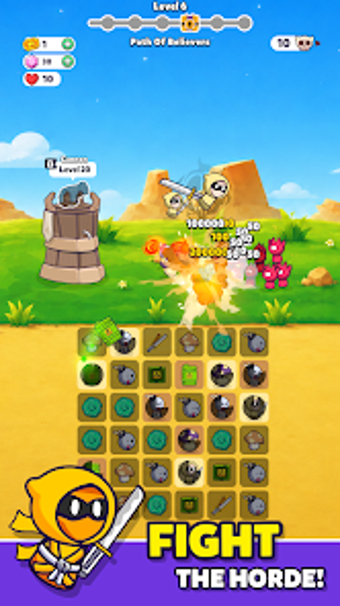
Unlike classic tower defense games that rely on manual placement, Match Fighters from Unico Studio blends merge-puzzle strategy with castle defense to reshape each encounter. Players drag and combine fighter pieces on a grid to produce higher-tier units while managing limited moves and wave timers. The app pairs unit classes, hatchable elemental dragons, and defensive upgrades into a tactical loop aimed at merge-puzzle fans and casual strategy players seeking short-session depth.
What kind of game is it?
The game is a hybrid of match-3 merging and tower defense, anchored in a grid-based core loop where you drag and merge pieces to create elite fighters. Matches of three, four, or five evolve units into stronger classes that then engage enemies automatically. Success depends on spatial decisions on the grid and move economy, so the primary play pattern is puzzle-driven army construction followed by automated wave resolution.
Does it focus on live control or tactical setup?
The design privileges pre-battle strategy over real-time command, using an auto-battle system that sends merged fighters into defensive waves. Players augment their setup with tactical boosters such as turrets and shields, and they progress by upgrading their castle to unlock offensive and defensive benefits. The developer balances planning (merge choices) with mid-battle interventions (consumable boosters) to create moments of high-stakes decision-making.
What does the game communicate visually and mechanically?
The interface centers on a compact grid and drag-and-drop merging, which keeps interactions concise for mobile play. Elemental dragon companions contribute distinct in-battle effects like raining fireballs or freezing foes, adding visible, system-level consequences to your merge choices. Android compatibility and regular updates keep the app current, and the six fighter classes supply clear mechanical roles to read at a glance.
Is progression and challenge well paced?
Progress relies on evolving units, hatching and upgrading dragons, and improving the castle to access higher-tier defenses. Limited moves and wave escalation create a steady difficulty curve that rewards careful planning and class management. Replay value comes from experimenting with combinations of the six classes, dragon element synergies, and using boosters during tighter waves, which encourages repeated short sessions rather than marathon playthroughs.
In summary, a match-centric strategy suited to planners rather than twitch players
The game is a solid choice for players who enjoy match-based tactical decision-making and short, repeatable defense encounters. It rewards methodical play and experimentation with unit classes and companions, while players seeking continuous direct control or fast-paced micro-management may find the experience less aligned with their preferences. Consider it a strategic puzzle with defensive stakes rather than a reflex-oriented tower combat title.